
The Claremont Institute Exposes Decades of Rot at Virginia Military Institute in New Report
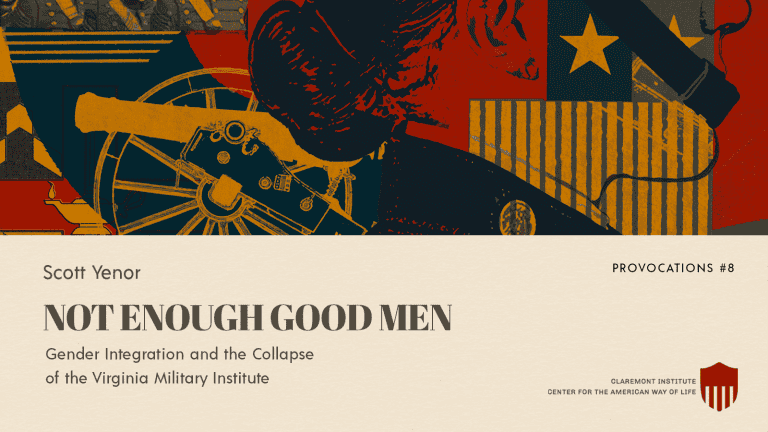
Washington, D.C.—The Claremont Institute’s Center for the American Way of Life has released a sobering and detailed report by Washington Fellow Dr. Scott Yenor on the consequences of mandated gender integration and the imposition of contemporary civil rights dogma at the Virginia Military Institute, a senior military college once celebrated for its commitment to forming men of honor and principle.
“This study makes clear that VMI’s transformation is emblematic of a national trend, where historic institutions lose their core purpose when forced to conform to modern sensibilities and bureaucratic mandates, rather than upholding their traditional standards and values,” wrote Yenor. “Restoring American excellence depends on respecting differences and defending institutions that cultivate virtue and leadership according to their founding mission.”
In 1996, the Supreme Court ruled in United States v. Virginia that the VMI was required to admit women—a dramatic shift of its unique adversative system and standards. Formerly, VMI’s code fostered a distinct ethos of qualities rooted in the Western tradition, among them honor and self-reliance. Under relentless pressure in the following years to demonstrate conformity to the new idols of equality and inclusivity, VMI revised its standards. The esteemed institution relaxed physical benchmarks and uniform standardization, while increasing its accommodations to female cadets.
Most jarring was the gradual transformation of the lauded “Code of a Gentleman” into the more inclusive “Code of a Cadet.” While the original Code was largely handed down by tradition and cadets themselves, the new Code is formal, and cadets are required to memorize it.
Efforts to remodel VMI in the image of the new civil rights regime ramped up in 2021 in the wake of social upheaval following George Floyd’s death. One report into the military college, commissioned by then-Gov. Ralph Northam, unsurprisingly prescribed diversity, equity, and inclusion policies as a remedy to fix longstanding “inequities” at the institution. Some of the suggested changes included dedicating funds to hiring more women, appointing a chief diversity officer, building a DEI plan, and intensifying implicit bias training.
“A DEI office and Title IX office now regulate VMI’s honor and class systems,” explains Yenor. “While the older code stressed that students should police themselves and stigmatized those who bypassed the student-led Honor Court, taking complaints to the administration directly is now said to be courageous when it involves exposing discrimination, defusing a ‘hostile educational environment,’ or putting a stop to ‘hazing.’”
Reversing VMI’s gender integration policy is a good start, but is ultimately insufficient. Restoring the military college and similar institutions requires affirmative efforts at the legal and political level to permit and encourage single-sex education and gender-specific training consistent with America’s founding values. VMI was once dedicated to cultivating manly honor and martial valor, and a new VMI should do that again. The Claremont Institute urges policymakers and the public to build schools that point men and women in different directions and to craft laws that uphold robust, time-proven traditions in military schools. This would meet the boy crisis and help save the republic.
The Claremont Institute chiefly recommends that the Supreme Court overturn United States v. Virginia in a manner that demonstrates the public can benefit from an arrangement that encourages and equips men and women for (at least somewhat) distinct life trajectories. A victory in a case like this would create space for additional victories that uphold sex-specific goals.
“The lessons of VMI should speak to every American concerned with the strength and character of our republic,” emphasizes Yenor. “True progress lies not in the flattening of differences, but in the flourishing of complementary excellence that honors both men and women in their distinct paths.”
About the Author
Dr. Scott Yenor is a Washington Fellow at The Claremont Institute’s Center for the American Way of Life, specializing in the intersection of feminism, sexual liberation, and the collapse of excellence in American institutions. Yenor is the author of Family Politics: The Idea of Marriage in Modern Political Thought and The Recovery of Family Life: Exposing the Limits of Modern Ideologies. He is a professor at Boise State University and a prominent scholar on the restoration of civic and family traditions.