
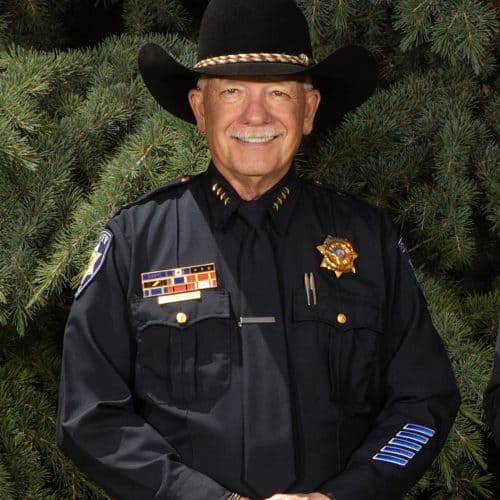
Sheriff Kieran Donahue
2025 Sheriffs Fellow
Sheriff Donahue is serving his fourth consecutive term as Sheriff of Canyon County, Idaho.
He was the 84th President of the National Sheriff’s Association (NSA) and is currently serving as Past President of the NSA. He is the first Idaho Sheriff ever to serve as President of the NSA. Sheriff Donahue serves on the NSA’s Border Security Committee, Government Affairs Committee, and Domestic Violence and Crime Victim Services Committee.
Sheriff Donahue has served for the past 11 years on the Executive Board for the Oregon-Idaho High-Intensity Drug Trafficking Area (HIDTA), funded by the Department of Justice’s Office of National Drug Control Policy (ONDCP). He was the recipient of the 2025 National HIDTA Directors Association Award.
He was appointed by Governor Little in 2021 to the Idaho Criminal Justice Commission and is currently serving as the commission’s Vice-Chair.
He is a past president of the Idaho Sheriffs’ Association (ISA) and a current member of the ISA Board of Directors.
Sheriff Donahue is the Chairman and co-founder, with his wife, Jeanie, of the K. Donahue Foundation (dba Man Up Crusade), a National and International non-profit public awareness campaign on the issue of domestic violence.
What is your current position?
Sheriff of Canyon County, Idaho. I am currently serving my fourth consecutive term. I also serve as the Past President (2024-2025) of the National Sheriffs’ Association.
What inspired you to choose this career path?
I started my law enforcement career in early 2003. I truly believe it was a calling from God that led me to a career in law enforcement. That same calling, along with the support of my family, and especially my wife Jeanie, is what led me to run for Canyon County Sheriff in 2012. It’s not lost on me how blessed I have been to serve the people of Canyon County for the past 22 years, with 13 years as Sheriff. I couldn’t have done it without God’s blessing and my family’s unwavering support.
How did you hear about the Claremont Institute?
I heard about the Claremont Institute from fellow sheriffs who had completed the Sheriff Fellowship.
What is your fondest memory of the Claremont Institute?
Honestly, the entire week I spent at the Sheriff Fellowship was incredibly memorable. If I had to narrow it down to one thing, it would be the intense, robust discussions I had with my fellow sheriffs and instructors about the important topics facing America and law enforcement in today’s ever-changing world. And how the threats to our democracy, though different today, also relate to the threats our democracy faced during the forming of our nation.
What do you believe will continue to make the Sheriffs’ Fellowship unique and relevant?
What makes the Sheriffs’ Fellowship stand out is that it gives sheriffs the chance to have meaningful conversations that are difficult to fit into the demands of the job. It brings together leaders from different parts of the country and different perspectives, but everyone shares the same responsibility to serve their communities while upholding the Constitution.
The challenges facing law enforcement will continue to evolve, but the need for principled leadership never changes. Fellowship creates the space to reflect on those responsibilities, learn from one another, learn from scholars and academic leaders, and return home with new ideas and stronger professional relationships. That combination of thoughtful discussion, historical perspective, and genuine peer-to-peer exchange is what will keep the Fellowship relevant for years to come.
Who is your favorite founder or statesman who has shaped American history and political thought, and why?
My favorite American founder is George Washington. What’s always stood out to me is that he didn’t just help secure independence; he helped define what independence would look like in practice. After leading the country through its earliest and most uncertain years, he chose to step away from power rather than hold onto it.
That decision, especially when he voluntarily stepped down after two terms as president, set a tone for everything that followed. He understood how easily a young nation could drift toward something resembling monarchy if power stayed in one person’s hands too long. By walking away, he made it clear that the presidency was meant to serve the country—not become the center of it.
What would the artifact be, if you could hold one piece of history from the early founding of our country, and why?
It would be a colonial musket. That necessary item of survival, not just in the securing of food and clothing, but a tool to protect yourself and your family and to take up that musket in defense of freedom and independence, is not that different from the rifle in our hands today. This is especially true for those of us in law enforcement. Those of us who use the weapon to put meat on our table, secure our homes, and protect our families also carry similar weapons to enforce the rule of law and to protect and serve the people of this independent nation. Additionally, we would be glad to stand and fight with this weapon to preserve our freedom and our independence, like those who took up arms to give us this right.
What qualities do you believe are necessary for effective leadership?
Honesty, integrity, determination, an ability to stand your ground and at the same time, the ability to listen and contemplate while showing a willingness to make decisions and follow through with those decisions.
A leader must have vision and lead from the front. A leader must have self-discipline, the ability to govern yourself before trying to govern others. It is a cornerstone of Stoic philosophy, and leaders like George Washington seem to have lived it in practice. Washington’s restraint, especially in choosing not to cling to power, carried more weight than many of his battlefield victories because it showed control over ego and ambition.
Another quality is clarity under pressure: focusing only on what you can control and refusing to be ruled by fear or emotion. Leaders who endure long enough to make a lasting impact tend to make decisions based on principle rather than reaction.
Finally, there’s a kind of moral consistency. People don’t expect leaders to be perfect, but they do notice whether someone’s actions line up with their stated values over time.
Do you have a favorite quote? Why does it resonate with you?
When I graduated from the law enforcement academy upon my entry into law enforcement, I had the distinct honor of giving the commencement speech for my class. I used my favorite quote during that speech (and many times since). It is a quote from Edmund Burke, “The only thing necessary for the triumph of evil is for good men to do nothing”.
This simple statement clearly emphasizes the need for vigilance, awareness, and the willingness to get into the battle when necessary.
What is the most distinctive attribute/character of the people in Idaho’s Canyon County you genuinely respect and appreciate?
I’ve always appreciated that Canyon County is a place where people haven’t forgotten who they are. There is still a strong Western spirit and Western heritage here. People take pride in earning what they have, they respect other people’s property, and they expect to be held accountable for their own actions. Just as importantly, they still respect the men and women who put on the badge. That doesn’t mean they expect perfection, but it does mean they recognize the value of the work being done. That’s a culture worth protecting because it benefits the entire community. For the most part, they understand and expect the enforcement of the Rule of Law, and that makes our job somewhat less cumbersome. The people of Canyon County, like most of Idaho, strongly believe in the Office of Sheriff and understand the Sheriff is elected by the people and represents the people.
What do you believe are the top three law enforcement issues currently facing America?
Right now, I see three core issues: recruitment, retention, and funding.
We’re not seeing enough qualified applicants entering the profession to replace those who are retiring or leaving early. At the same time, agencies are struggling to retain experienced personnel due to heavy workloads, public pressure, and limited resources. This is in large part due to the negative rhetoric against law enforcement by the left and the Presidential terms of President Obama and President Biden, where we experienced not just very little support, but in many instances, outright defamation and calls to abolish law enforcement at every level. This has drastically led to a negative impression of our profession that we are likely to struggle to overcome for years.
And the reality is, none of that can be separated from funding. If we expect a professional, well-trained, and highly accountable law enforcement system, it must be properly resourced. Otherwise, we’re asking agencies to meet rising expectations without the tools to do it. County, city, and state legislative bodies must prioritize public safety in their appropriations and budget allocations, recognizing it as the essential foundation upon which all other government services depend.
What do you believe can be done to prioritize hardening soft targets in today’s volatile environment, i.e., public gatherings?
We clearly live in a dynamic and changing environment in reference to safety during public gatherings. I believe we can depend on three fundamental principles to achieve the highest possible safety margins, with, of course, no guarantees; there is an urgency to continue to assess and adapt to an ever-changing threat picture.
- Technology: Utilize and deploy evolving and available technology to and around these sites, based on current best practices and resource availability. Technology includes but is not limited to camera systems, scanners, manometers, etc. These technology assets must be coordinated with and integrated into a central operations center to maximize and analyze incoming data, which can then be processed and distributed accordingly.
- Staffing: Adequate staffing of personnel at each event, for evaluation of the threat landscape and deployment of resources before, during, and after events are taking place. Staffing to facilitate the operations center and distribution of critical data and information, as well as appropriate numbers of armed personnel at key locations throughout the event location. Staff should be at levels that exceed the customary or former threat analysis that show adequate numbers.
- Venue Access: Although restricting or limiting access points to event venues may cause some impatience and/or complications to attendees, restricted venue access needs to be comprehensively evaluated, analyzed, and implemented. Vehicle access, foot traffic, etc. need to be taken very seriously and will likely require additional manpower, barricades, armored vehicles, etc. This may cause some challenges to law enforcement, event producers, and attendees, but it is the necessary and correct approach.
If you could communicate one thing to politicians and Americans alike about the importance of policing, what would it be?
If there’s one thing I’d want both elected officials and the public to really comprehend, it’s that policing isn’t something that can be handed off and expected to “fix” everything on its own. It only works when everyone involved—leaders, communities, and law enforcement—accepts that they all have a role in understanding that policing is paramount for a safe and freedom-based society.
Law enforcement can respond when something goes wrong. They can investigate, intervene, and help restore order when things fall apart. But what they can’t do is substitute for the day-to-day decisions that either keep a community stable or slowly pull it off track. That part belongs to all of us, whether we like it or not. Society has a role. Society has a responsibility to support and work collaboratively with law enforcement. Law enforcement and policing are not meant to be kept in the shadows and only appear when things are going badly. The presence of full-time, adequately staffed, and trained law enforcement once again helps ensure our society is safe in our homes, schools, workplaces, and in our recreation. The absence of law enforcement and good policing can and will result in victimization and chaos.
If you look at places and periods in history where things functioned well, you usually see the same ingredients: laws that are clear and applied evenly, leaders who don’t get swept up in every headline or pressure cycle, and a public that understands policing as something connected to them, not something standing apart from them. When any of those pieces start to drift, the effects don’t stay contained to one group or one side of a political debate.
At the end of a stressful day what brings you peace of mind?
That I can honestly thank God for allowing me to serve in my capacity. To know that I face each day armed with the knowledge that right is right and wrong is wrong, and that I have daily stood my watch on the wall and I did not retreat, and I did not fail. And with that, I can find some solace. Knowing that tomorrow I will find the strength and the courage to face it all again, and I will not be alone. I will have a whole host of people like me who have been called to this duty by God, and we will prevail. And at the end of my career I will know I answered His call, no matter the cost, and I find peace in that every day.
What is the most important idea Americans need to protect and defend about the American Way of Life?
It can be taken from us.
America needs to grasp the understanding of the fact that we are a country that, while great in winning our independence and establishing a democracy 250 years ago, our country, our vision of freedom, our rights as individuals, and so much more are not guaranteed. We must be vigilant in our protection of our country’s borders, its maritime regions, its economy, its freedom of religion, its freedom of speech; in other words, everything we espouse to be America. Our country and its success and world power are hated by many. There are foreign countries and actors who want nothing less than to destroy our Republic and the freedoms we enjoy. A certain percentage of America, unfortunately, tends to forget the past and falsely believe we are immune to these threats. We are not. We must find a way to educate and impress upon our younger generations the fallacy that America can survive all threats brought against us. To survive and pursue the great liberties and way of life that we enjoy, we must always be ready to stand together and defend it against all enemies, foreign and domestic.