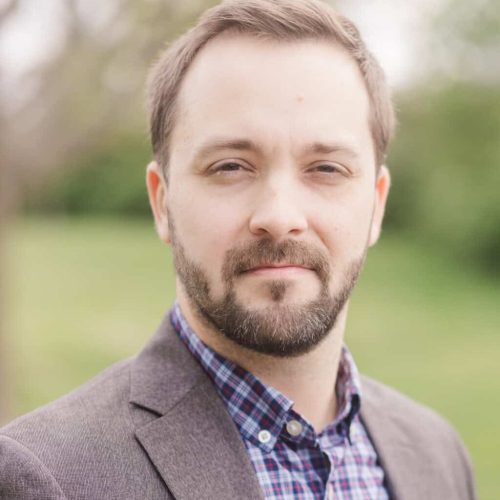
Mike Sabo
2024 Lincoln Fellow
Mike Sabo is the Managing Editor of The American Mind, an online journal of the Claremont Institute. He is also an Associate Editor at American Reformer, which promotes a vigorous Protestant approach to the cultural challenges of our day. He has written for numerous outlets, including RealClearPolitics, City Journal, Modern Age, Public Discourse, The Federalist, and American Greatness. He is a graduate of Ashland University and Hillsdale College and lives with his wife and two children near Cincinnati.
What is your current position?
I am the Managing Editor of The American Mind and an Associate Editor at American Reformer.
What inspired you to choose this career path?
Peter Schramm, one of the founders of the Claremont Institute and its first president, opened my eyes to the importance of the American Founding and the possibility of political philosophy. He interviewed me for the Ashbrook Scholar Program at Ashland University while I was still a high school senior. He showed me my own ignorance and then graciously allowed me entrance into the program. I was struck by two things: his love of America was a fire that could never be put out, and he was the first person I encountered who displayed what I only later came to understand as magnanimity.
What are you currently working on?
Editing and commissioning pieces for The American Mind. Our current symposium, which was kicked off by Claremont’s own Scott Yenor, highlights the importance of single-sex education. Soon we will be starting two symposiums simultaneously: the first on what the new litmus test should be for nominating judges in a post-Roe world, and the second will feature a spirited debate over IVF. I will also be starting my weekly column for American Reformer today.
How did you hear about the Claremont Institute?
I first heard about Claremont from Peter Schramm, who always made sure that copies of the Claremont Review of Books were available to students. He also talked fondly about a professor of his, Harry Jaffa. He told us that Jaffa’s books were too hard for us, but then said we should read Jaffa’s books anyway. The first book of Jaffa’s that I read was Crisis of the House Divided, which was the second hardest book I’d read up until that point (Allan Bloom’s Closing of the American Mind was the hardest).
What is your fondest memory of the Claremont Institute’s Lincoln Fellowship?
Being on the Duffy boat ride with some of the other fellows and their families.
There are all sorts of educational programs out there for current and rising conservative professionals. What do you think makes the Claremont Institute’s Fellowships unique?
The depth of discussion and the caliber of the fellows Claremont gets, year in and year out, stand out, which is why so many of them are currently serving in the Trump administration. They are a crucial part of the project to save America.
Who would it be, why, and what would you discuss, if you could have a conversation with an American Founder, or any great thinker?
I’ll pick an American Founder: Alexander Hamilton. Though never a president, Hamilton was a republican renaissance man, a soldier and a statesman who used his vast intellect and skill on behalf of the nation he loved. Perhaps most importantly for our day, he understood that the economy served the country, not the other way around.
Who was more important for their time, George Washington or Abraham Lincoln? Why?
Though some may scoff at Lincoln’s claim that he had a greater task ahead of him than what Washington faced, he was right.
Looking back on history, in which one of the original 13 colonies would you have wanted to live and why?
Virginia or South Carolina, especially given my interest in the Book of Common Prayer and the Anglican tradition.
What qualities do you believe will make outstanding statesmen/women in this century?
Prudence and courage.
What do you believe is the greatest challenge facing the United States today?
How we manage immigration will determine America’s fate.
What do you believe has led to our established culture redefining itself in the 21st century?
It was the long, slow decline of the WASPs in the 20th century, combined with the early Progressives’ and New Deal liberals’ decades-long assault on republican government, followed by the destructive forces unleashed by the New Left and their epigones, who wormed their way into the institutions they tried to blow up.
What do the words “life, liberty, and the pursuit of happiness” mean to you?
Passing on the traditions and practices of a healthy civil order to the next generation. And freedom understood not as license but as working within the limits of the moral law to achieve the common good of the nation.
What will it take for people to believe the field of journalism still has legitimacy as a purveyor of truth (who, what, where, when, why) vs. opinion?
This will happen when our current media institutions go out of business and are replaced by ones that don’t carry water for the ruling class.
What books are you currently reading?
The Camp of the Saints by Jean Raspail and King of Kings: A Reformed Guide to Christian Government by James Baird.
Do you have a favorite quote? Why does it resonate with you?
“That if thou shalt confess with thy mouth the Lord Jesus, and shalt believe in thine heart that God hath raised him from the dead, thou shalt be saved.” – Romans 10:9
What is the most distinctive attribute/character of the people in the state where you grew up that you genuinely admire?
I’m an Ohioan, born and raised. Though imperfect, our people mean well and are loyal.
Where do you hopefully see this nation in five years?
A strong, confident nation that is the envy of the world—and is fueled by the consent of its citizens rather than the cravings of the managerial elite.