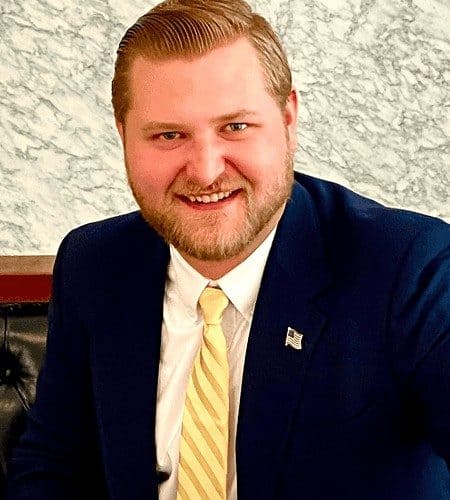
Caleb Pirc
2025 John Marshall Fellow
Caleb serves as Director of the IFPC Legal Center—Idaho’s only state-based conservative legal center—and as General Counsel for the Idaho Family Policy Center. As Legal Center Director, Caleb represents parents, families, and ministries facing violations of their constitutional rights, taking cutting-edge conservative legal fights to the courtroom. Prior to his current role, Caleb served as a Deputy Attorney General in the Civil Litigation and Constitutional Defense Division of the Idaho Office of the Attorney General, where he helped defend the constitutionality of Idaho’s laws. He is a Claremont Institute John Marshall Fellow, a Blackstone Fellow, and an Allied Attorney with Alliance Defending Freedom. His work has been published by the Heritage Foundation, the Regent University Law Review, the Federalist, the American Mind, the Grove City Journal of Law and Public Policy, and the Daily Signal.
Caleb received his Juris Doctorate from Regent University School of Law where he served as Symposium Editor for the Regent University Law Review, Vice-President of the Federalist Society, Vice-Chair of the Trial Advocacy Board, and was awarded the American Legal Institute’s Scholarship and Leadership Award. Caleb grew up in Idaho, built a sheep business selling breeding stock across the country, worked in Idaho politics, was a candidate for the Idaho House of Representatives, and graduated from Liberty University with a Bachelor’s degree in Business Administration: Entrepreneurship.
What is your current position?
Director, IFPC Legal Center
General Counsel, Idaho Family Policy Center
What inspired you to choose this career path?
When I was in college, I had the opportunity to do some policy work at the Idaho Legislature. During that experience, I saw just how much of an outsized influence lawyers had in directing policy discussions. I had always been passionate about doing what I could to keep Idaho the kind of state where I would want to raise my family, so I went to law school to develop the knowledge and skills to defend our way of life here in Idaho.
What are you currently working on?
The IFPC Legal Center is the only Idaho-based nonprofit conservative legal center, and we’re building out the conservative legal movement here in Idaho. We are working on a number of pro bono constitutional and civil rights cases, producing amicus briefs in several major cases, writing academic legal scholarship to advance conservative principles in Idaho’s law, and building a network of aligned attorneys across the State.
How did you hear about the Claremont Institute?
Theo Wold—a John Marshall Fellowship alum himself—highly recommended the program to me while in law school. I noted it for future consideration and later applied at the encouragement of Dr. Scott Yenor.
What is your fondest memory of the Claremont Institute?
I thoroughly enjoyed the deep review of the American Founding. Not only did we dive into the Founding documents, but we also read what the Founders read, studied them as people, and discussed the depth of their reason and intellect.
There are all sorts of educational programs out there for current and rising conservative professionals. What do you think makes the Claremont Institute’s Fellowships unique?
Claremont fellowships are not just another professional achievement to add to the resume, although they are indeed one such achievement. The Claremont Institute genuinely trains its Fellows, providing them with massive amounts of reading material and impactful lectures that cultivate intellectual discussion and provide exceptional training on the principles of the American Founding. If you want just a week away from responsibilities to add another checkbox to the career list, Claremont is not for you. If you want to thoroughly engage with the Western legal and political traditions in a way that prepares you for defending and preserving our heritage, then you should apply for a Claremont Fellowship.
Who would you hope the individual would be, if you could sit down and enjoy a fireside chat with an American Founder or any great thinker? What would you discuss?
George Washington. Washington’s name has become so commonplace that few recognize the truly rare combination of faith, virtue, and character that defined our first president. Dr. Matthew Peterson rekindled my love for Washington during the John Marshall Fellowship. Given the chance to talk with Washington, I would want to ask him about his faith, a topic that has been distorted in favor of the secularist narrative. A more thorough review of the life and writings of the father of our country illuminates a man whose life was defined by his faith, beliefs that were not just intellectual but that governed his life as he governed the nation.
What would the artifact be, if you could hold one piece of history from the early founding of our country? Why?
I would want to hold George Whitefield’s Bible. The Great Awakening laid the spiritual and moral foundation for the Founding, stoking the fire of liberty in the soul of the clergy and the common man alike. Whitefield’s Bible would have traveled across the country and been read to thousands of the colonists.
In which one of the original 13 colonies, looking back on history, would you have wanted to live? Why?
Massachusetts. The Massachusetts colony was greatly influenced by Puritan political thought and was filled with faithful Christians intent on ordering society around truth.
Who was more important for their time, George Washington or Abraham Lincoln? Why?
George Washington. Lincoln was faced with the difficult task of preserving the Union, but Washington had the more difficult task of forging it. America had to fight for its independence—Washington led its tattered band to victory against the largest empire in the world. The new free American states had to unite, a task that seemed impossible given the growing division and national tensions—Washington presided over the Constitutional Convention, shepherding our Constitution to ratification with his political capital. America had to establish the successful peaceful transition of power—Washington stepped down from the presidency, ensuring that such a nearly unprecedented transition occurred under his care. Each of those tasks required a different kind of skill and different virtues; yet Washington handled each with the steady, strong presence that defined him as a man.
What do you believe is the greatest challenge facing the United States today?
John Adams famously remarked in a 1798 letter to the Massachusetts militia that our government was “wholly inadequate” for all but a “moral and religious People.” One would be hard-pressed to label many corners of American society with such a moniker. Not only are we increasingly losing the shared religious beliefs that defined the Founding, but we more fundamentally disagree about what constitutes morality. Worse, many Americans reject wholesale the existence of morality as part of the created order. The shared understanding that our laws must conform to the “laws of nature and nature’s God” has been replaced with the farce that the whims of the majority should govern. That is what led to the demise of the French Revolution, and it will lead to our demise as well if we fail to recover the moral fabric necessary to support a robust polis.
What do you see as the biggest challenge in attempting to reach and convince a large percentage of left-leaning individuals the nation’s founding principles are still relevant and must be preserved?
The steady attack on the Founders has eroded our national identity and removed our shared heroes. Now, instead of debating the merits of their opinions, Americans are taught to reject those men as people and, with them, all of their ideas. We no longer venerate those who were willing to pledge their “lives, fortunes, and sacred honor.” That assault on the Founders as men has caused many on the Left to have no interest in even considering our nation’s founding principles.
What qualities will make outstanding statesmen/women in this century?
The assassination of Charlie Kirk made one thing clear: the radical Left will stop at nothing to silence those who speak the truth. As Vice President Vance said in a speech, “We’re not going to solve any of [Western Civilization’s] problems unless we have the courage to speak the truth, unless we have the courage to live the truth.” What America needs in its statesmen is an unwavering commitment to the truth that God built into the created order. And that courage must be backed up by the courage to be called all the names, be canceled by all the powerful people, and be personally attacked and maligned for living that truth out in every aspect of life.
What would you hope the subject be, if you should find yourself presenting a case before the US Supreme Court?
The freedom of Christians to think and act biblically in the political arena. That could take a variety of forms, but too often the political Left tells those who believe Christianity—the faith that serves as the foundation for this nation—that their beliefs are not welcome in the public square. If I had to pick any case to argue, it would be one defending the rights of Christian statesman to live out and govern in accordance with those principles.
What do you see as one of the greatest threats to this country’s liberty?
An electorate that does not value liberty.
What do you think has been the major contributor to the demise of our country’s lack of political civility?
The attack on objective truth. Society stops debating and starts yelling the moment that we are no longer trying to mutually discover the truth built into the universe. We cannot seek to disagree civilly once we stop viewing our fellow citizen as an ally in discovering that truth and instead view them as a roadblock to the imposition of our political preferences.
Has there been a public policy issue you are most proud of having a hand in moving the issue forward and perhaps into law?
Defense of the preborn. I have had numerous opportunities over my professional career to stand for those who are truly voiceless: the children in the womb. A society that tolerates the destruction of its fellow citizens for matters of convenience will not flourish. I was honored to help defend Idaho’s protections for preborn life while working as a Deputy Attorney General, recently filed a Ninth Circuit amicus brief on behalf of a majority of Idaho’s legislators supporting their constitutional authority to protect preborn life, and have been vocal in defending Idaho’s laws from an attempt to change them through ballot initiative.
What books are you currently reading?
George Washington’s Sacred Fire by Peter Lillback and Leaving a Legacy by Johann Kurtz.
What book, movie, or speech has left a lasting impression on you? Why?
Theodore Roosevelt’s Man in the Arena speech hangs on my office wall. It serves as a great reminder that it “is not the critic who counts,” but the statesman who puts in the hard work and leaves it all on the field, although he may fail.
Do you have a favorite quote and if so, would you share?
“Have the courage to have your wisdom regarded as stupidity. Be fools for Christ. And have the courage to suffer the contempt of the sophisticated world.” – Justice Antonin Scalia
What is the most distinctive attribute/character of the people in the state where you grew up that you genuinely admire?
Idaho is one of the most faithful states in the country. I am grateful to have grown up in a community marked by faith—the kind of moral and religious people that Adams understood as necessary for society.
At the end of a stressful day what brings you peace of mind?
Benjamin Franklin summed it up well at the Constitutional Convention when he said “I have lived, Sir, a long time and the longer I live, the more convincing proofs I see of this truth—that God governs in the affairs of men.” Knowing that—no matter what results from my labors for my state and nation—it is Christ who now eternally reigns gives great peace because it is not ultimately in our hands. We are tasked with preserving this great society we have been given, but ultimately the outcome is outside of our control. Revelation 11:15 makes it clear: “The kingdoms of this world have become the kingdoms of our Lord and of His Christ, and He shall reign forever and ever!” That is my hope that brings me peace.
Where do you see yourself and this country in five years?
I hope to continue to work within the conservative legal space in some form, whether that be here, back in government, or in elected office.
As far as the future of the country goes, I hope that the nation continues to reject the radical Left’s ideology and that our leaders return to the stable statesmanship of the founding.